Anti-nuclear power protests spread throughout Japan
Tuesday, March 13, 2012

Fukushima, in the Eyes of the World (2)
Continued from NHK News 7 (English) on March 11, 2012
A nation-wide problem of storing radioactive waste
Fukushima, in the Eyes of the World (1)
One year after the Great Tohoku Disaster, here's the latest numbers:
Death: 15,854 (1,605 in Fukushima, no death from radiation)
Missing: 3,155
Evacuees: Over 60,000 households
The following clip is from NHK News 7 (English) on March 11, 2012
Death: 15,854 (1,605 in Fukushima, no death from radiation)
Missing: 3,155
Evacuees: Over 60,000 households
The following clip is from NHK News 7 (English) on March 11, 2012
Nuclear accident according to TEPCO
and the problems of radio-contamination.
Sunday, March 11, 2012
3/11, 2:46 pm - Iwaki Station, Fukushima

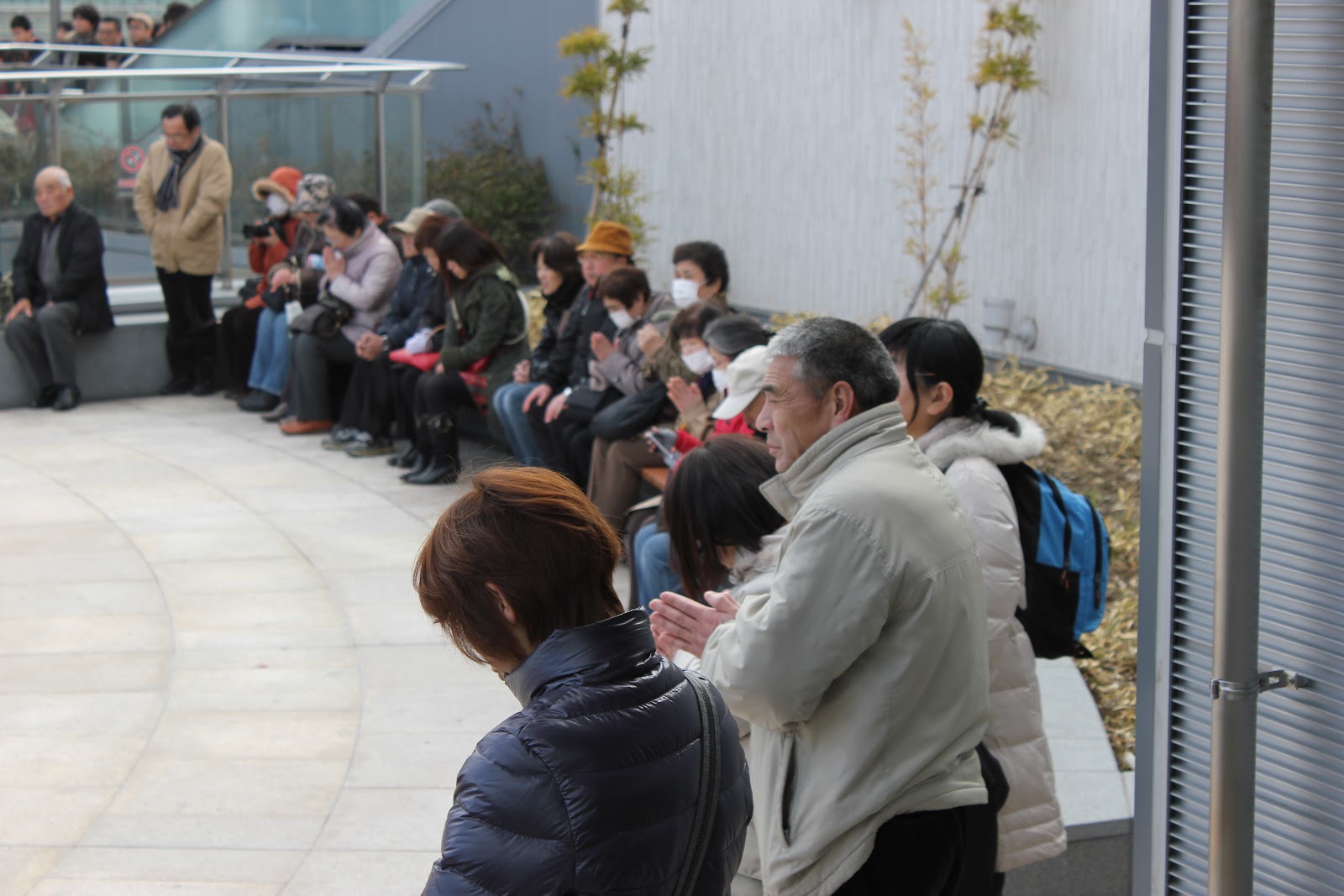
Japan observed the nation-wide 1 minute silence today at 2:46 pm to commemorate the anniversary of the Great Tohoku disaster. Midori and I stopped at the train station in Iwaki after church.

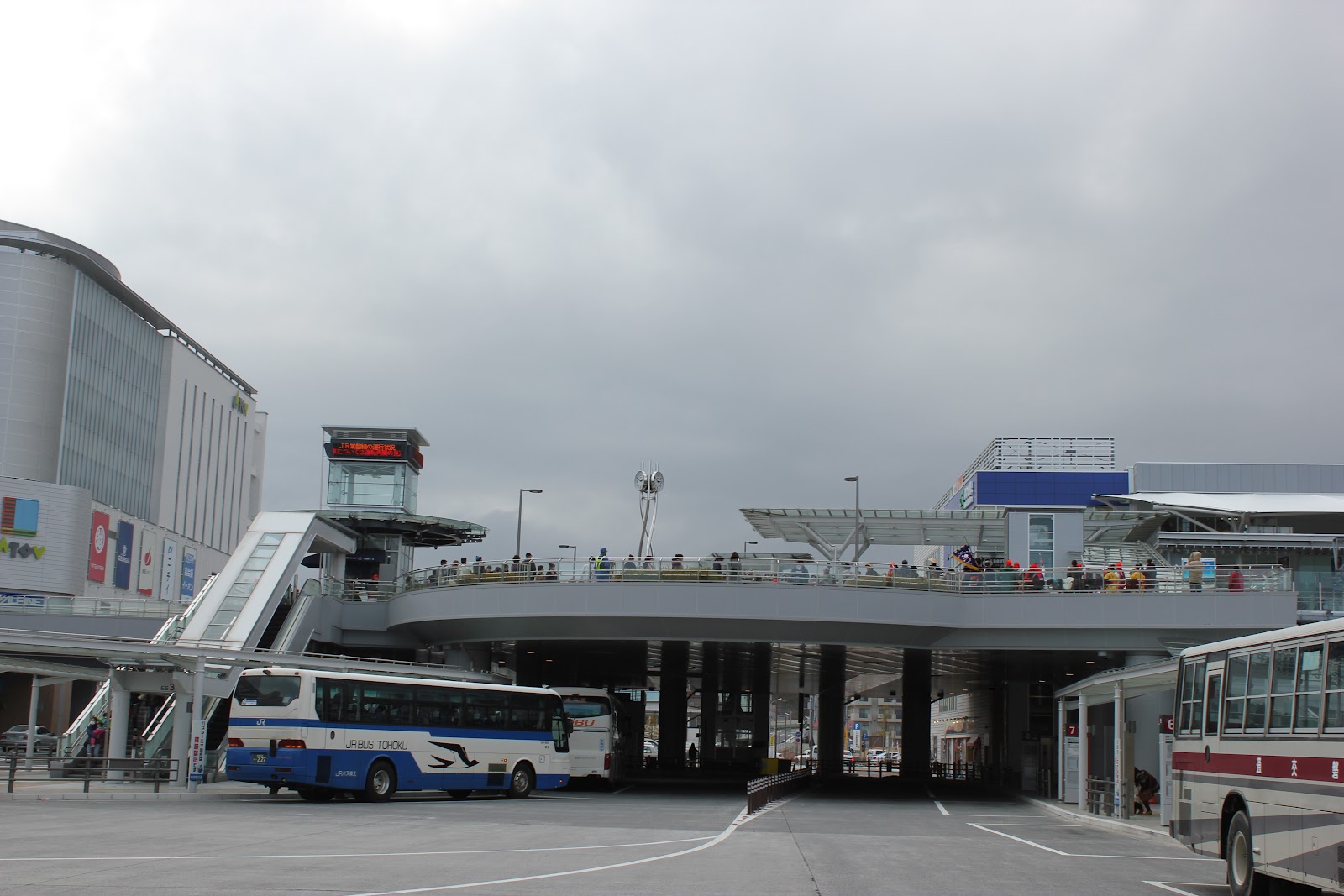 |
| Iwaki Station Square, view from the street |
Thursday, March 8, 2012
Nagasaki - a detour en route to Fukushima
March 8, 2012 - Nagasaki, Japan
It's my fourth visit to Fukushima and this time it includes a detour in the south via Hiroshima and Nagasaki. Why Hiroshima and Nagasaki? We want to learn how Christians engaged in restoration of communities and cities after the atomic bombing at the end of World War II and bring that learning to and for Fukushima.
Today Midori and I spent most of the day to walk around the city of Nagasaki to learn its history, culture and people and visited a couple of museums, including the 26 Martyrs Museum. The museum was opened in February 5, 1961, on 364th anniversary of the crucifixion of the 26 saints in Nagasaki. It was the very first official persecution on Christians in Japan, and only to be followed by thousands and thousands more shortly after that.
 It was an inexplicable moment. Horror, sorrow, awe, reverence, and gratitude. This is best I could describe the movements of my emotions. St. Paul Miki, one of the 26 martyrs, a Japanese Christian said to his offenders as he was dying on the cross:

Soon after this tragic event took place on the hill of Nagasaki, the rich and the powerful started to build a tight control over foreign trade as they were afraid of Christianity being further spread to Japan. So they built an artificial island, Dejima, to keep all foreigners (Portuguese first then Dutch as part of their East Indian Company trade) on that small area of 120 m x 75 m (9000 square meters, a fan-shaped island with only one bridge to the mainland) and controlled all the trade routes to a small port in Nagasaki. They wanted science, technology, education, weaponry from the West, but no Christianity.


Japan was a newly unified nation by the warlord Hideyoshi who invaded and kept the war with Korea for seven years, with an ambitious plan to take over the mainland. He died only a year and a half after he ordered the 26 Christians to be killed in Nagasaki. Since mid 17th century Japan closed itself to the rest of the world for over 200 years in fear of the growth of Christianity in its homeland. Some Christians fled to Macau and majority of other Christians went underground. Because of this persecution, Japanese Christianity quietly grew in its unique and authentic form during this dark age. Bibles that were translated to Japanese were all burned and there was no priest to shepherd this secretly growing community. They often carried Buddhist symbols with Christian symbols hidden deliberately so their faith would not get exposed to outsiders.

I stood on the second floor of the captain house in Dejima, where captains of Dutch East Indian Company trade ships would come and stay. Looking though the window, all I could tell was the passage of time. The small artificial island is now completely locked in by the expansion of the city, after surviving the atomic bombing. I could only see the hills behind the Nagasaki Customs building as if this hidden history is now completely surrounded by the modern urban noise.
 Midori and I walked to the warf and wandered around a bit along the water. This quiet water is enclosed by gentle hills. Honestly, it is hard to believe how much this little narrow port carried the tragedies and silence for the last 500 years or so.

It's my fourth visit to Fukushima and this time it includes a detour in the south via Hiroshima and Nagasaki. Why Hiroshima and Nagasaki? We want to learn how Christians engaged in restoration of communities and cities after the atomic bombing at the end of World War II and bring that learning to and for Fukushima.
Today Midori and I spent most of the day to walk around the city of Nagasaki to learn its history, culture and people and visited a couple of museums, including the 26 Martyrs Museum. The museum was opened in February 5, 1961, on 364th anniversary of the crucifixion of the 26 saints in Nagasaki. It was the very first official persecution on Christians in Japan, and only to be followed by thousands and thousands more shortly after that.


All of you who are here, please, listen to me. I did not come from the Philippines. I am a Japanese by birth, and a brother of the Society of Jesus. I have committed no crime, and the only reason why I am put to death is that I have been teaching the doctrine of Our Lord Jesus Christ. I am very happy to die for such a cause, and see my death as such a great blessing from the Lord.
At this critical time, when, you can rest assured that I will not try to deceive you and I want to stress and make it unmistakably clear that man can find no salvation other than the Christian way. The Christian law commands that we forgive our enemies and those who have wronged us. I must therefore say here that I forgive Taikosama (Hideyoshi). I would rather have all the Japanese become Christians.
(From Luis Frois, Martyrs Records, 1597)
Soon after this tragic event took place on the hill of Nagasaki, the rich and the powerful started to build a tight control over foreign trade as they were afraid of Christianity being further spread to Japan. So they built an artificial island, Dejima, to keep all foreigners (Portuguese first then Dutch as part of their East Indian Company trade) on that small area of 120 m x 75 m (9000 square meters, a fan-shaped island with only one bridge to the mainland) and controlled all the trade routes to a small port in Nagasaki. They wanted science, technology, education, weaponry from the West, but no Christianity.


Japan was a newly unified nation by the warlord Hideyoshi who invaded and kept the war with Korea for seven years, with an ambitious plan to take over the mainland. He died only a year and a half after he ordered the 26 Christians to be killed in Nagasaki. Since mid 17th century Japan closed itself to the rest of the world for over 200 years in fear of the growth of Christianity in its homeland. Some Christians fled to Macau and majority of other Christians went underground. Because of this persecution, Japanese Christianity quietly grew in its unique and authentic form during this dark age. Bibles that were translated to Japanese were all burned and there was no priest to shepherd this secretly growing community. They often carried Buddhist symbols with Christian symbols hidden deliberately so their faith would not get exposed to outsiders.

I stood on the second floor of the captain house in Dejima, where captains of Dutch East Indian Company trade ships would come and stay. Looking though the window, all I could tell was the passage of time. The small artificial island is now completely locked in by the expansion of the city, after surviving the atomic bombing. I could only see the hills behind the Nagasaki Customs building as if this hidden history is now completely surrounded by the modern urban noise.


On the plane coming to Japan last weekend, I was overwhelmed by the thought that it's been only twelve months since the disaster happened last March, and we've experienced so much and Japan has been going through a quiet crisis again. What will the future hold? We do not know.
One thing I am grateful though is that Nagasaki already taught so much about the resilience and unwavering faith of our forefathers and mothers who gave us more than enough to find ways for Fukushima's future, and perhaps for the rest of us, too.
Saturday, February 25, 2012
Tribute to a local pastor in Tuzhar, Ukraine
I just received a note from a friend in Kiev, Ukraine telling me that Pastor Bogdan went to be with the Lord. Pastor Bogdan welcomed me and my translator, Mirav to his church during my short visit to Tuzhar (30 KM away from Chernobyl nuclear plant). Two weeks ago he was diagnosed with blood cancer and he died soon after that.
When I visited him and his church last October, he shared his vision and prayer requests with me (read the story on his church here):
1. Please pray for the local church to be the light and salt in the area, to live with faith, not with fear.
2. Send more teachers for Sunday school as the number of families and children are increasing now as the region finally started revitalization 26 years after the devastating disaster in Chernobyl and nearly 13 years after the nuclear plant was permanently closed (read the story on Chernobyl Museum here).
Now I would like to ask you readers of this blog to pray for this local church as they go through grief of losing their shepherd and that God may send another shepherd to comfort them and prepare them for the important mission of rebuilding their community.
Pastor Bogdan,
Thank you for your courageous leadership and commitment in your community. May you rest in God's peace and His loving presence!
Wednesday, January 18, 2012
Blessings and the blessedness: Globalization of the Cross
Happy Chinese New Year!
That’s right, the year of dragon is around the corner. While Japanese do not celebrate this ancient oriental lunar calendar system any longer, the Chinese New Year, or the Korean New Year, is the time when everyone wishes good luck and blessings to others. Forget the hardships, misfortunes, and sad events of the year before. Look ahead toward a bright new year with hope and anticipation for more happiness, more success and for more fortune. Please the good gods and they will bring you good luck. Appease the bad ones, so they don’t get angry with you. That is the bottom-line of the earth-bound eastern spirituality (or animism and shamanism). Good luck, fortune, prosperity and happiness. That’s the traditional meaning of the word, 福 (fu in Chinese, and fuku in Japanese and bok in Korean).
Gospel comes from a Greek word, εὐαγγέλιον (euangelion), where we get the word, evangelical, and it means good news. Or big announcement that the King of the heaven and earth came into the human history and fixed everything once for all. It is indeed good news, true happy news that the King of all kings is coming again and the earth will receive her king again!
Gospel is translated to 福音, good sound, or good news in Japanese, Chinese and Korean. It is the gospel of Jesus Christ, on which the meaning, purpose and direction of happiness and prosperity is set eternally and it tells you who the Giver of all good gifts is. One of the biggest discoveries on the journey of Fukushima disaster recovery has been our learning of the historical meaning of the name, Fukushima and the rich Christian history in Japan just few hundred years ago (See the blog entry, Fuksuhima, the Land of Good News here. Scroll down to listen to the interview in the same entry).
However when the gospel was first introduced to this part of the world several centuries ago, it did not come through easy ways. After the work of Francis Xavier in Nagasaki in the mid 16th century, Christianity started growing rapidly and Japanese used to call those believers Kiristan (see the map here where thriving Christian communities were). We do not hear about this history at all because it got all silenced violently for about 200 years after one tragic event. And for some of us, who are evangelicals outside Japan, have tucked away this important history that took place before the modern evangelicalism we know now rose in history.
On February 5, 1597, twenty six Christians (3 Jesuits, 3 Franciscans from Europe and Mexico, and 20 Japanese) were crucified by the order of Toyotomi Hideyoshi, at the height of his political career as the national leader. He once was in favor of Christianity in the hopes that he could get new weaponry from the West through Christians but he soon realized that was not what Christianity was about. Hideyoshi and other politicians who followed him saw Christianity as a greater threat than anything they had seen in building their earthly kingdom of fear and sword because Christians did not fear anything but their heavenly King who brought true peace and true prosperity. Christians had a transcendent view of life, an abundant and truly blessed life.
Christianity in Japan was spread through and the church was built on the blood of martyrs basically. The church went underground in Nagasaki and other places, and some of the Christians, with help of Jesuits, fled to Macau, the Portuguese colonial and trade base in the Far East of that time. They took refuge among Macanese and built houses and settled down (Jeremiah 29). They helped the church in Macau by their trade and craft skills. They helped building the very first Western University and theological seminary in Asia under the leadership of Italian Jesuit architect between 1622 and1642. Most of the building was burned at a fire in 19th century, but the beautiful façade still remains at St. Paul Cathedral.
 Less than two decades ago, the Portuguese government restored many historical sites in Macau in preparation of handover to China. In St. Paul Cathedral they discovered crypt with a massive pile of bones in it. Some of the relics belonged to the twenty-six martyrs of Nagasaki. The crypt is now converted to a musem of sacred art and there is this amazing painting covering one side of the wall as you see below. The original painting was burned at the fire mentioned above and this is a replica.


Globalization of the Cross.
This painting was done by an unknown artist around 1640 and clearly shows the globalized world through the gospel and the cross a few hundred years before our time. A very different kind of globalization than what we see today which is globalization of power, money and greed. The work of Gospel in the 16th and 17th centuries was a converge between the east and the west where the heaven was extended to earth through these martyrs who had unwavering faith in Christ Jesus alone. They knew there was life after death. That Easter hope kept them alive even at the moment of death. They knew what it means to be blessed.
Blessed are the poor in spirit, for theirs is the kingdom of heaven.
Blessed are those who mourn, for they will be comforted.
Blessed are the meek, for they will inherit the earth.
Blessed are those who hunger and thirst for righteousness, for they will be filled.
Blessed are the merciful, for they will be shown mercy.
Blessed are the pure in heart, for they will see God.
Blessed are the peacemakers, for they will be called children of God.
Blessed are those who are persecuted because of righteousness, for theirs is the kingdom of heaven.
Blessed are you when people insult you, persecute you and falsely say all kinds of evil against you because of me.
This hope of new humanity found in Christ is now being rediscovered and retold among local churches in Fukushima as they continue to walk humbly before God and love mercy and doing justice among their suffering neighbors. History always illuminates enough light to navigate the future.
A common myth about Japan and evangelism held by many modern missionaries from the West and from Korea is that Japan is a hard soil to sow the Gospel. I think people say this because they did not dig deep enough to touch the deep roots of the church of these fearless forefathers and foremothers in faith. We forgot how seriously these early evangelicals took the Gospel and shared with their neighbors fearlessly. This good new is still good and true for the whole earth and humanity today amidst dark, chaotic mess of natural and man-made disasters we face today.
These powerful testimonies are well preserved at Twenty-Six Martyrs Museum in Nagasaki
Subscribe to:
Posts (Atom)