Tuesday, April 10, 2012

Community of Easter Hope (1): Restoring the fabric of soceity

I met Mr. Suzuki for the first time at Global Mission Center in Iwaki last November when I went to visit Usuiso village with a few members of GMC. GMC has been very instrumental from the first day of the disaster on March 11, 2011, in reaching out to the whole city. It soon became a popular place of community service, fellowship and networking (read the story about GMC - here). Mr. Suzuki lost most of his family due to the tsunami, and his home was completely washed away. But he didn't give up even after such tragedy and shock.

The third day of the disaster, on March 13, 2011, he became a group leader of the Usuiso shelter where he was evacuated to. The first food distribution from the city was only one onigiri (an onigiri is a rice ball, not enough for an adult) for 28 people in the shelter for a whole day. As a leader, he went through very hard times because he didn’t know to whom he should give the only onigiri. 

Onigiri, half a size of an adult's palm
Furthermore, he could not tell anyone that there was only one onigiri. Mr. Suzuki met a man at the shelter who had driven from Sendai all the way to the shelter. This is a distance of approximately 200 km. He was trying to find his father, whose house was destroyed by the tsunami. The man had not had anything to eat for several days because he could not find anything at the shops on his drive from his home. Mr Suzuki decided to give the one onigiri to this man, and told him to eat it in secret, hiding it from everyone.

The next day, there were only four onigiri. The situation made him very sad, and he no longer thought that he could continue in his role as a group leader. He asked another senior to take over his role, and quit as group leader.

Mr. Suzuki started visiting the community cafe run by GMC and started getting to know some of the volunteers and staff. He comes to the cafe in hopes of meeting his neighbors and friends with whom he completely lost touch because of the tsunami. For nearly 8 months, he could not return to Usuiso village because of painful memory. However, the day when I visited, he finally decided that he wanted to return to Usuiso with us for the first time because he felt better after friendly Christians prayed for him and were kind to him.


Mr Suzuki: The old people living in this neighbourhood used to get together in the community centre several times a day, around 6 am, 10 am, between 1 and 2 pm after lunch, and in the summertime after dinner as well.
Volunteer (woman’s voice): Since they could always meet each other, they did not exchange phone numbers.
Mr. Suzuki: We did not exchange our emails either, so now I still have no idea where they are.

Volunteer (woman’s voice): How do you feel about visiting here today?
Mr. Suzuki: I felt like I did not want to come.
Volunteer (woman’s voice): You came today although you did not want to, right?
Mr. Suzuki: I did not want to see this landscape…

Volunteer: You haven’t been back here for a long time, have you?
Mr. Suzuki: I have not been back here for a month. I just do not want to see this landscape.

For Mr. Suzuki, the loss of friends and neighborhood is even more devastating than the loss of his fishing boat and house.
 
At a department store in Iwaki Train Station

Many survivors suffer from trauma and economic loss, and more importantly they suffer from loss of their social fabric - family, friends, neighbors and their communities. 
Community centers and department stores offer spaces for people to connect and also allow nonprofit organizations to run their programs of providing disaster victims with opportunities to connect with others. 

 
Mr. and Mrs. Watanabe moved to Koriyama city soon after the disaster. They were helped by Grace Garden Chapel and I met with them in my visit last November - just a few days before I met Mr. Suzuki in Iwaki. I was visiting Koriyama in order to meet with them and a few other victims in order to hear their stories at the church. They arrived a bit earlier than the scheduled interview time and when I came out of the interview room with women from an earlier interview, they were very surprised. They burst into joy and laughter to find out their neighbors were alive after the disaster!   

 
Mr. Watanabe: Oh yes! You were an office worker in Kitamachimuki!
Woman (interviewee): You fixed the blinds for us. I didn’t recognize you by name.
Ms. Matsumoto (relief worker): When I asked you if you knew Motomu Watanabe, you told me it was difficult to recognize him by name.

Mr. Watanabe: Indeed, it is difficult to recognize just by name.
Woman (interviewee): When I saw your face, I recognized you.
Mr. Watanabe: It is a relief to see someone I know.
Woman (interviewee): Surely, it is.

Local church, restoring the fabric of community 

People often think relief work is about providing relief goods to individuals and families - physical resources. People underestimate, however, the power of connecting people and restoring relationship in that early stage of relief work. The restoration of social fabric is an important foundation for carrying out long term recovery work, and is a foundation the local church cannot afford to bypass. It can be done rather quietly like the way how it happened in Grace Garden Chapel above, or it can be done more intentionally like GMC's vision to rebuild Usuiso community. Pastor Ikarashi is passionate about the prophetic vision God gave him to serve this community by rebuilding economy, providing education and alternative energy so Usuiso can become a model community from which the rest of Japan will come and learn.
Ikarashi, showing the new community design

Saturday, April 7, 2012

Holy Darkness and Holy Silence: The Paradox of Looking and Listening


Today is Holy Saturday. We find it difficult to know what to do on this day of waiting caught between Good Friday and Easter. It has only been the last few years that I began to understand darkness and silence as holy gifts, after spending several weeks to learn how to pray in silence with some Jesuits. Ever since then, I’ve been nurtured by God’s mysterious power through this holy darkness and holy silence.

Jesus is laid in the tomb. No light. No words.

He died on the cross and was laid in the dark tomb silently on Sabbath. The darkness of the tomb, absence or disabling effect of looking puzzles me more than the death itself because of the power of God to raise the dead, from the first fruit, his own son, Jesus.

Sun deities of the modern day

After opening themselves to the world in the late 19th century and lifting the ban on Christianity, Japan’s major drive was to build a strong modern nation with military power and modern science. To rise up again to the world as the empire of the rising sun.  When eyewitnesses of the atomic bombing in Hiroshima cried out, “The sun is falling down!,” it shook the foundations of political identity and imperial militarism of Japan at the end of the World War II.

‘Tae-Yang-Chul,’ (April 15) or the Day of the Great Sun is the birthday of the late leader of North Korea, Kim Il-Sung, whom the people worship as the great Sun of the peninsular.  April 15 is the most important holiday in North Korea and the starving nation is going to celebrate the 100th birthday of their dead leader at a very high cost this year. The North Korean government announced that they would launch a rocket some time between April 12th and 16th in celebration. This is now creating much fear and tension in the islands of Japan (bizarrely enough my own country, South Korea, seemed to be quiet about this during and after the Nuclear Security Summit.)

There is much fear and tension in the Far East region right now and the whole world is watching how this modern day 'Sun deity worship' will unfold. Please pray for North Korea, a place where Christianity was vibrantly growing just over 100 years ago (see this short documentary of the 1907 Revival and church history in Korea – here).  

The God of all creation, including light and day; sun, moon and stars, is still at work in absolute darkness and deep silence. He works with his creation under the sun, he exists above the sun, and he performs his miracles of raising the dead - without the sun.

The power of darkness and silence of God overcomes the fear of death and the fear of uncertainty. The day in the tomb is just not a day sandwiched between Good Friday and Easter Sunday in hopeless waiting. The mystery of life is completed even when we can’t look and when we can’t listen. 

The local churches in Fukushima continue in their work of recovery and building a future, including the complex reality of energy issues (such as stopping nuclear or going solar, or something totally different.) My prayer for Fukushima on this Easter comes from the ancient liturgy of Holy Saturday below:

The Reading for Holy Saturday in The Liturgy of the Hours

Something strange is happening on earth today – a great silence, and stillness. The whole earth keeps silence because the King is asleep. The earth trembled and is still because God has fallen asleep in the flesh and he has raised up all who have slept ever since the world began. God has died in the flesh and hell trembles with fear.

He has gone to search for our first parent, as for a lost sheep. Greatly desiring to visit those who live in darkness and in the shadow of death, he has gone to free from sorrow the captive Adam and Eve, he who is both God and the son of Eve. The Lord approached them bearing the cross, the weapon that had won him the victory. At the sight of him, Adam, the first man he had created, struck his breast in terror and cried out to everyone: “My Lord be with you all.” Christ answered him: “And with your spirit.” He took him by the hand and raised up him, saying “Awake, O sleeper and rise from the dead, and Christ will give you light.”
The Pastor: A Memoir, by Eugene Peterson.

Seeing with the Eyes of Faith (4)


Faith, a gift from God.

Seeing with the Eyes of Faith (3)

Our spirit desires the perfect world, the world created by God. 

Seeing with the Eyes of Faith (2): Father Aguilar of Nagasaki


How does one see such devastating disasters in Fukushima and make sense of life? Midori and I had a very special conversation with Father J. Jose Aguilar Colio, S.J. from Mexico who has been living in Japan for 59 years. He was one of the founding members of the 26 Martyrs Museum in Nagasaki back in 1962.

He had a simple message about this way of seeing with the eyes of faith: “Get deeper.”
 

From Nagasaki to Fukushima: Seeing with the Eyes of Faith (1)


Good Friday and Easter frame a very powerful way of looking. A different way of seeing the world. The crucifixion and resurrection of our Lord, Jesus, reconciled all things through him to the heavenly Father. All things. All men and women. Nothing is left untouched by the blood of Jesus.

When our eyes are fixed on him, the world begins to look different. It is that simple.
Crucifixion (Stained glass window at 26 Martyrs Cathedral in Nagasaki)
Death
Resurrection


In order to see Fukushima with eyes of faith, I want to revisit the powerful story of Nagasaki, the Christian spiritual home of Japan in order to navigate the journey toward building Fukushima with Easter Hope.

It is almost impossible to visit Nagasaki without realizing how different Nagasaki is from the rest of the country, mostly due to the remarkable two historical events that took place there. The first event is the introduction and growth of Christian faith despite the brutal persecutions of Christians for over 200 years. After the first official persecution of 26 Christians in 1597, thousands of people lost their lives because of their faith. Unlike any other cities in Japan, over 10% of the population in Nagasaki claims to be Christian.

The second major event is the atomic bombing on August 9, 1945. There is a subtle but very important difference between Hiroshima and Nagasaki because of the quiet influence of Christianity and the sacrificial love poured out by Christians over the centuries. Christianity did not grow as a victorious triumphant religion from above or as a source of riches and upward social mobility and prosperity from outside, but rather grew as the source of eternal life and hope that produces perseverance and resilience from within and among people (whether they were formerly noblemen or slaves) to face suffering, and threats and fear of death here and now.

Urakami Cathedral was first built by a French priest and Kakure Khiristan, or hidden Christians who came out of hiding underground after the ban on Christianity had been lifted in 1895. When the construction was complete in 1925, it was the largest Catholic church in East Asia. But an atomic bomb dropped by a so-called Christian nation destroyed the Cathedral and over 8,000 Christians on that day (about 10% of people killed in Nagasaki).
The hyper-center of A-bombing (left) and the part of Urakami Cathedral remains (right)
The recovery process of Nagasaki after the World War II in Nagasaki has been characterized by the quiet, peace-building restoration of society by Christian leaders like Dr. Takashi Nagai (read my tribute to him on August 9, 2011 - here). His recollection of the tragedy is important for us to hear again and to understand how worldly events might be interpreted with the eyes of faith.   
“It is significant, I believe, that Urakami Cathedral was dedicated to her. We must ask: Was this convergence of events, the end of the war and the celebration of her feast-day, merely coincidental or was it the mysterious Providence of God?
I have heard that the atom bomb… was destined for another city. Heavy clouds rendered that target impossible and the American crew headed for the secondary target, Nagasaki. Then a mechanical problem arose and the bomb was dropped further north than planned and burst right above the cathedral… It was not the American crew, I believe, who chose our suburb. God’s providence chose Urakami and carried the bomb right above our homes. Is there not a profound relationship between the annihilation of Nagasaki and the end of the war? Was not Nagasaki the chosen victim, the lamb without blemish, slain as a whole-burnt offering on an altar of sacrifice, atoning for the sins of all the nations during World War II?”

(A Song for Nagasaki, p. 188)

Broken statues of saints from the old Urakami Cathedral moved to the new cathedral.

A little corner of the new building of Urakami Cathedral is filled with broken statues of saints. The faith of martyrs flows through the centuries and the stories of the past is always a vital part of the powerful now.

Sunday, April 1, 2012

Fukushima in the Eyes of Faith: A Year in Review

Palm Sunday, 2012.
MATTHEW 21:9

"Hosanna to the Son of David!"
"Blessed is he who comes in the name of the Lord!"
"Hosanna in the highest heaven!"
Jesus makes a triumphant kingly entry to Jerusalem, the city of peace. He enters to bring peace and his method of doing this is by offering his own life, as the Suffering Servant. His journey en Via Dolorosa begins today. At the end of that suffering, he overcomes the fear of death on the cross and offers a new life, life in him with the Easter hope. This hope has been, and continues to be the compass for our journey en route to Fukushima. I spent the whole day to reflect on my own journey to Fukushima for the past year since I first visited Fukushima and since I started this blog.

My first intention to start this blog was to share some stories of the local churches in Fukushima only for one week between Palm Sunday and Easter last year but the story kept growing. I went to visit three more times since last April.

In my first visit last April, I learned the nuclear crisis firsthand in addition to the devastating earthquake and tsunami. My Japanese team identified their strategy to work with local churches between 20-60KM radius outside the crippled Fukushima Dai-ichi plant.

In July visit, we offered a retreat to 25 church leaders from various cities in Fukushima and helped form them into a network, Fukushima Christian Network. These pastors came together to lament and to grieve the magnitude of the loss and the scale of the combined disasters (read their prayers of lament here).  They wrote a declaration together, called the Fukushima Future Declaration (Read here). They recognized the significance of this disaster and the role of the church in the restoration of Fukushima, drawing on the historical meaning of the name, Fukushima (福島, the land of Gospel - read here). They also found strength in the evidence of the thriving Christian communities prior to persecution in the 17th and 18th century in the Fukushima area.


In November visit, I learned how deep and wide the history of Christianity in Japan has been since the 16th century mission by Jesuits. The persecuted Christians fled from Japan and went to Macau. They helped building communities and educational establishments in Macau(read here).

In March visit, we hosted three events, one of which is Fukushima Youth Forum. A group of 50 youth from Fukushima, other parts of Japan, and nations such as the USA, Canada, and Hong Kong gathered in Inawashiro, Fukushima prefecture for the Fukushima Youth Forum. For two days, the youth explored how their personal stories fit into God’s big story. Based at a government camp in the snowy mountains, they worshipped, prayed and enjoyed fellowship. They were challenged to look for the purpose of their lives while serving their suffering neighbours in the disaster-affected areas. In a way, serving in Fukushima is a pathway for these youth, helping them to find their life calling, while simultaneously fulfilling the current calling on their lives - to serve the immediate needs of their neighbours in Fukushima, Miyagi and Iwate (the three prefectures affected by the earthquake and tsunami).


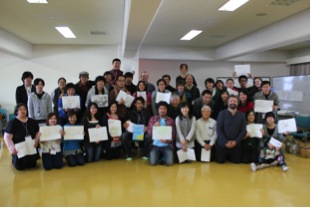
Youth Forum participants holding drawings they made that envisage the future of Fukushima
Visiting Usuiso village tsunami site. The local church, with their prophetic imagination, hopes to rebuild the whole community, beginning with a listening post.
 We must recognize that in Fukushima, one year after the disaster, the work of the local church has only just begun. Rebuilding Fukushima’s local economy and its future according to God’s plan for his kingdom on earth will take decades. Each of us must continue to pray for Fukushima so that it may truly become its namesake – the Land of Blessing.

Each of the local churches we visited shared remarkable stories of their resilience and tenacious work, but more importantly, their stories point to one powerful truth: We serve a living God who loves his creation and sacrificed his own life to restore all he created to himself. That's the promise of the gospel, the most powerful story we are reminded again in this Holy Week on the way to the Cross.  

Isaiah 42
The Servant of the LORD
 1 “Here is my servant, whom I uphold,
   my chosen one in whom I delight;
I will put my Spirit on him,
   and he will bring justice to the nations.
2 He will not shout or cry out,
   or raise his voice in the streets.
3 A bruised reed he will not break,
   and a smoldering wick he will not snuff out.
In faithfulness he will bring forth justice;
 4 he will not falter or be discouraged
till he establishes justice on earth.
   In his teaching the islands will put their hope.”
 5 This is what God the LORD says—
he who created the heavens and stretched them out,
   who spread out the earth with all that springs from it,
who gives breath to its people,
   and life to those who walk on it:
6 “I, the LORD, have called you in righteousness;
   I will take hold of your hand.
I will keep you and will make you
   to be a covenant for the people
   and a light for the Gentiles,
7 to open eyes that are blind,
   to free captives from prison
   and to release from the dungeon those who sit in darkness.
 8 “I am the LORD; that is my name!
   I will not yield my glory to another
   or my praise to idols.
9 See, the former things have taken place,
   and new things I declare;
before they spring into being
   I announce them to you.”